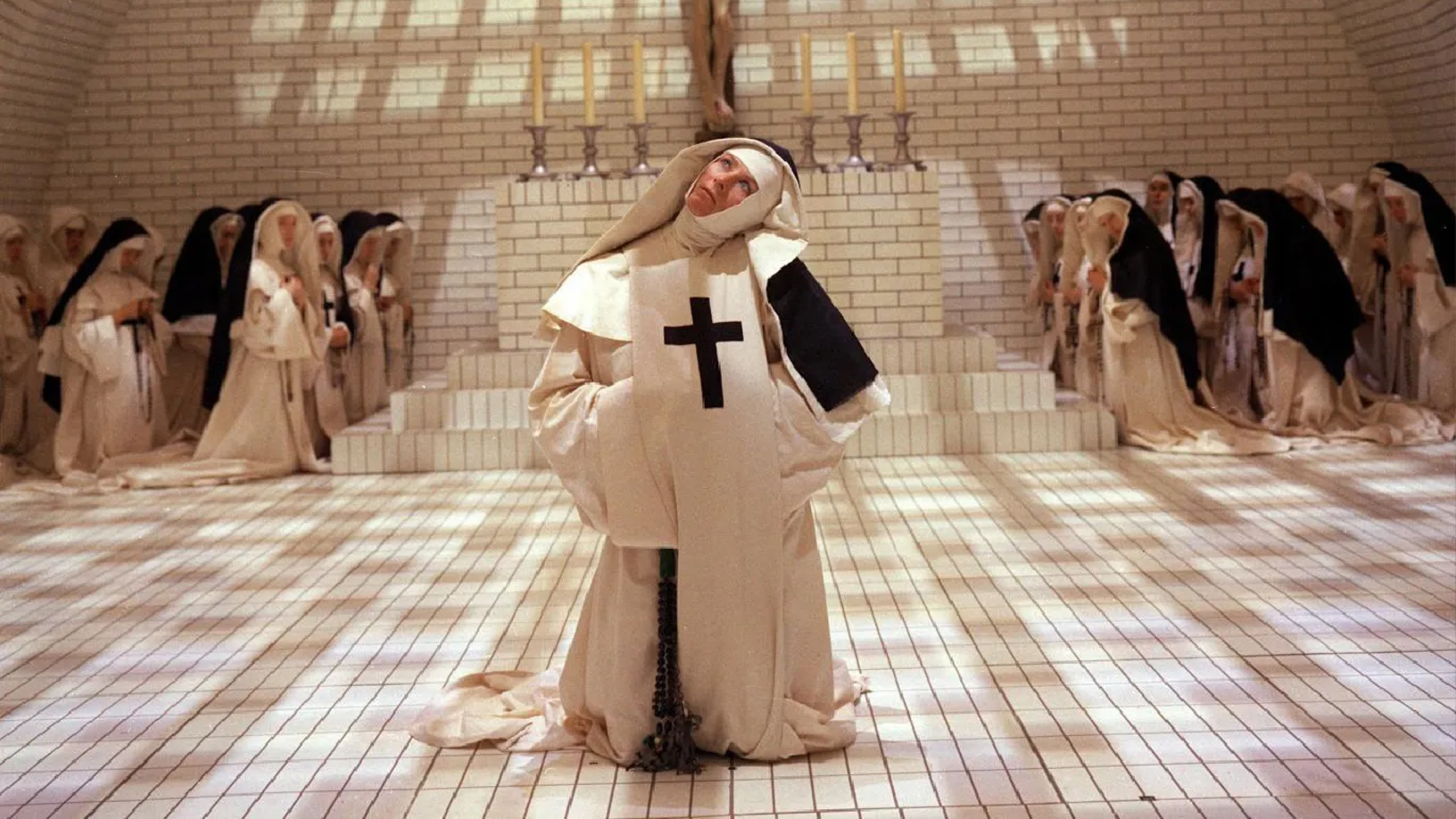
The reputation of Grandier—a corrupt, libertine friar in the small town of Loudun—piques the curiosity of the convent’s Mother Superior, who proposes that he become the nuns' spiritual advisor. Grandier’s refusal unleashes the Abbess’s ferocious rage; she succumbs to frenzied madness, a behavior mirrored by her fellow nuns. Certain adversaries of the friar exploit this mass hysteria to eliminate him, accusing him of being responsible for the satanic phenomenon. Grandier is sent to the stake.
At the 1971 Venice Film Festival, the film was accused of blasphemy, sparking a storm of controversy that led to its seizure.
In its uncut version, “it is an uncompromising masterpiece—even more relevant in these ‘post-truth’ times than it was when Russell first gave shape to its unforgettable excesses of burning intensity. This is the version of The Devils that Ken Russell hoped would one day be accessible to an international audience: an uncompromising masterpiece, even more relevant in these ‘post-truth’ times than it was when Russell first gave shape to its unforgettable excesses of burning intensity.” (Mark Kermode)
“My most political film—indeed, the only one.” That is how visionary director Ken Russell described his incendiary 1971 masterpiece. […] Yet, since its release to mixed reviews fifty-five years ago, The Devils has never been distributed in the form he intended […]. The story told by The Devils is utterly compelling and draws on extraordinary real-life events that culminated in the execution by burning of a priest, Urbain Grandier, in the French town of Loudun in 1634. […] Despite their seemingly fantastical nature, the historical facts upon which The Devils is based are well documented […]. However, the most famous of the many accounts remains Aldous Huxley’s novel The Devils of Loudun (1952), acknowledged as a source for Russell’s film alongside John Whiting’s play The Devils, first staged by the Royal Shakespeare Company in 1961. Russell was “electrified” by Huxley’s book and wanted his film to provoke an equally intense reaction in the audience. For him, it was “a story about brainwashing.” Although he had converted to Catholicism many years earlier, Russell was convinced that the events at Loudun had nothing to do with demons or the supernatural, and everything to do with political corruption and weaponized hysteria. […] Shot at Pinewood Studios on sets of extraordinary visual purity designed by a young Derek Jarman, *The Devils* was a controversial project from the start. […] Russell’s original vision proved to be ahead of its time: certain key sequences were deemed too intense for audiences of the era. In particular, an entire scene was cut in which a public display of alleged ‘demonic possession’ culminated with hysterical nuns tearing down and desecrating a massive crucifix; further cuts were made for the British version, and additional edits were imposed for American audiences. For Russell, these changes were agonizing because, as he confided to me in 2002, the excised material not only contained “some of the best things I’ve ever done” but also embodied the film’s thematic heart: a blasphemous spectacle—a farce brazenly staged for corrupt political ends. (Mark Kermode)


