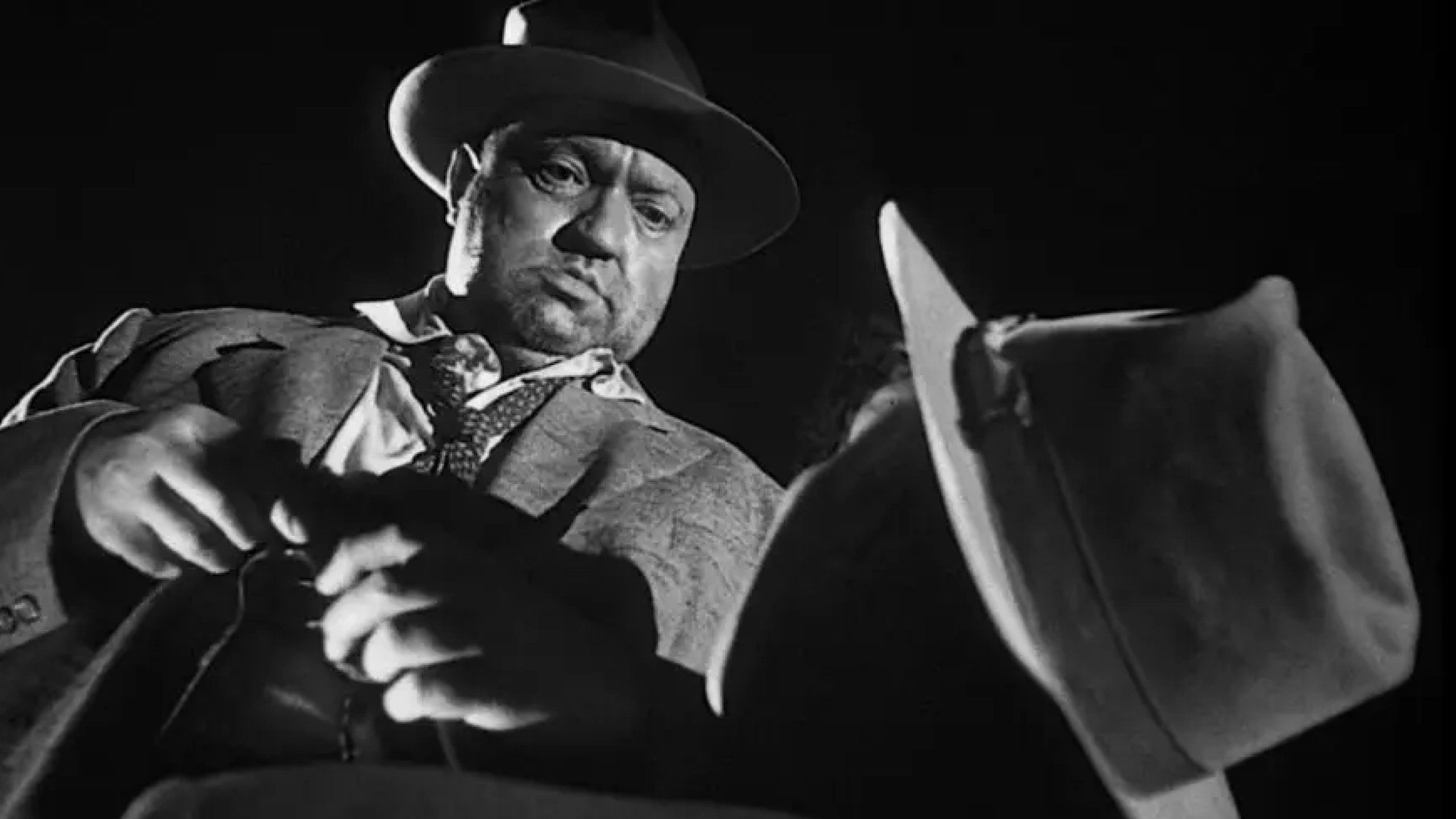
A dynamite blast kills two people near a border crossing just as a Mexican police officer is passing by. He takes an interest in the case and discovers that Captain Hank Quinlan—officially in charge of the investigation—is planting false evidence against a suspect. As his investigation continues, the officer learns that Quinlan has spent years framing suspects using this method of fabricating evidence. Realizing what is happening, he attempts to expose his superior but succeeds only in provoking a violent reaction.
In 1957, Orson Welles finished shooting Touch of Evil and completed an initial cut of the film. After viewing it, the studio wanted to improve it by adding scenes and re-editing the footage. Welles saw their version and immediately wrote a passionate, 58-page critique demanding changes to the editing. This version attempts to honor those requests, presenting Touch of Evil exactly as Orson Welles intended.
A complex 1958 noir by Orson Welles, set on the border between the United States and Mexico. Supported by a stellar cast that includes Janet Leigh and Charlton Heston, Orson Welles himself takes on the lead role of the corrupt police officer Hank Quinlan. The famous opening sequence is spectacular; filmed without cuts, it is a long take that follows a car through the streets of the border town for three and a half minutes.
Good and evil are indistinguishable in the brutal world of drug traffickers. This was Welles’s final American film; he subsequently worked only in Europe to escape the constraints imposed by the studio system. For the film, his friend Marlene Dietrich transformed herself into the dark-haired Tanya, a brothel madam who reads the cards for a Hank already destined for an inexorable end. Although she plays only a supporting role, Dietrich is essential to the plot and to the character Welles created for himself; to quote Dietrich’s biographer Steven Bach, the actress embodies the boundary between Mexico and the United States, as well as that between good and evil. Dietrich and Welles had known each other since the days they performed for the troops, and the actress—who never held back her criticism—later said: “I did everything he wanted. […] He is a great man. A genius.” “People ought to cross themselves before saying her name.” At nearly sixty, the actress appears much younger in the film, and it is evident that she thoroughly enjoys the role, with its occasionally vulgar language. On March 19, 1958, *Variety* wrote: “Dietrich is a rather sensual and entertaining spectacle.” And while at the time it was dismissed as a “sex and crime” movie, today it is considered a masterpiece. (Peter Mänz)


